WhatsApp, Instagram and Messenger AI Customer Support Is Now One Click
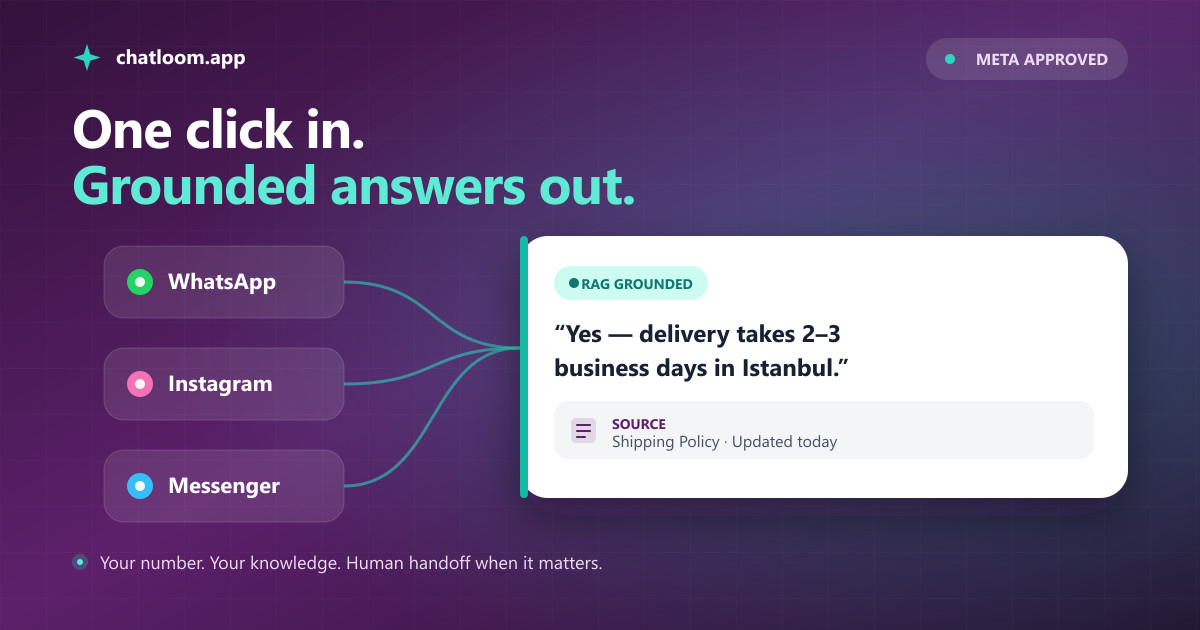
On August 6, 2026, Meta approved Chatloom for instagram_manage_messages, whatsapp_business_messaging and whatsapp_business_management. That approval removes the developer-app obstacle; the bigger opportunity is giving every customer a fast, grounded answer from the business's own knowledge.
In this article
- Why Do Unanswered DMs Turn Into Lost Sales?
- Why Was Connecting Meta Channels So Difficult Before?
- What Changed on August 6, 2026?
- Is One-Click Connection the Real Breakthrough?
- How Does RAG Keep Customer Answers Grounded?
- What Happens When a Customer Wants a Human?
- How Does Multilingual Support Work Across Channels?
- What Can the AI Agent Actually Do After Connection?
- How Can a Business Start in Three Steps?
- Frequently Asked Questions
Why Do Unanswered DMs Turn Into Lost Sales?
Unanswered DMs turn into lost sales because customers treat WhatsApp, Instagram and Messenger as live conversations, not support tickets. A buyer asking about delivery, stock or a return policy is often deciding whether to purchase right now. If the reply arrives hours later, the buying moment—and sometimes the customer—has already moved on.
The problem compounds quickly. The same team may be watching a website inbox, an Instagram account and one or more WhatsApp numbers while also doing the work that generates revenue. Questions arrive at lunch, after closing and during campaigns. The easy questions repeat; the valuable edge cases disappear between them.
Centralizing those conversations matters, but speed alone is not enough. A fast wrong answer about price, availability or policy can cost more trust than a late answer. The goal is therefore not simply to automate messages. It is to answer immediately, in the customer's language, from information the business can stand behind.
Why Was Connecting Meta Channels So Difficult Before?
Connecting Meta channels used to be difficult because every business effectively needed a small integration project. The old path meant creating a Meta developer app, choosing permissions, generating and refreshing tokens, configuring webhook URLs and verification secrets, subscribing assets, recording review videos and waiting roughly one to three weeks for App Review.
That work was reasonable for a platform engineering team; it was unreasonable for a restaurant, clinic, online store or agency that simply wanted to answer customers. A single mismatch in a redirect URI or webhook subscription could produce a connection that looked healthy but never received a message.
The result was a hidden tax on customer service. Businesses either hired technical help, copied fragile token instructions or postponed the channel altogether. Chatloom went through that review and provisioning work at the platform level so each customer no longer has to repeat it.
What Changed on August 6, 2026?
On August 6, 2026, Meta approved Chatloom's instagram_manage_messages, whatsapp_business_messaging and whatsapp_business_management permissions; Messenger was already approved. WhatsApp, Instagram DMs and Messenger are therefore live for real Chatloom customers through Meta's embedded connection flow.
A business now starts the connection with one click, signs in to Meta, selects the relevant assets and can be ready in about 60 seconds. There is no Chatloom-specific developer app for the business to create, no access token to copy and no webhook endpoint to maintain.
This is a Tech Provider model, not a shared-number service. Every business connects its own WhatsApp number, page and Instagram account through Embedded Signup. Meta bills that business directly for its API usage. Chatloom does not sit between Meta and the bill, and it does not add a commission to Meta's usage charges.
Is One-Click Connection the Real Breakthrough?
One-click connection removes the setup barrier, but answer quality is the real breakthrough. A channel can be connected perfectly and still damage the customer experience if the agent invents a return window, recommends an unavailable product or responds with generic advice that ignores the business.
Useful automation needs two layers. The first is reach: WhatsApp, Instagram and Messenger messages arrive in one operating system and receive a prompt response. The second is grounding: every factual answer must come from the business's own website, documents, policies and product information.
That second layer is why Chatloom is not just a Meta inbox with an AI text generator attached. It uses retrieval-augmented generation—RAG—to turn the company's approved knowledge into the evidence behind each answer.
How Does RAG Keep Customer Answers Grounded?
RAG keeps answers grounded by retrieving the most relevant passages from the business's own sources before the model writes a response. The agent is not asked to remember the company from the public internet; it is given the exact evidence needed for the question in front of it.
The pipeline starts with sources. Chatloom crawls the business's website and ingests documents and help content. It removes low-value page furniture, then splits useful text along sensible boundaries so a shipping rule or product condition does not lose its meaning. Each passage is converted into an embedding: a numerical representation of meaning that lets the system match ideas even when the customer uses different words.
When a message arrives—"Can I return an opened item after two weeks?"—the system also turns that question into a search representation. It retrieves the passages that are semantically and lexically closest, ranks the candidates and supplies the best evidence to the model. The response is instructed to rely on those sources. If the knowledge base does not support an answer strongly enough, the safe outcome is to say so or hand the conversation to a person, not fill the gap with a plausible guess.
That is the difference from simply asking ChatGPT. A general model can explain what return policies usually look like, but it does not know this company's current exception, market or product category unless those facts are provided. RAG provides them at the moment of the question and keeps the answer tied to material the business controls. It also means an updated policy can take effect through a source update instead of retraining a model.
For the conceptual foundation, read what RAG is and how retrieval changes an AI response. For the engineering layer behind reliable retrieval, see our production RAG systems guide. If you are preparing sources now, the practical next step is training an AI agent on your own data.
The business result is simple: customers get specific answers about the company they contacted, while the team can trace quality back to the knowledge it supplied. Connection brings the conversation in; RAG makes the response worth receiving.
What Happens When a Customer Wants a Human?
When a customer explicitly asks for a human, the AI agent steps aside and the conversation moves into Chatloom's Inbox for a person to continue. New customer messages are still saved, but the AI no longer interrupts the human conversation.
The request is detected with high-precision phrases across all 10 supported languages. Chatloom can notify the business owner by email and, when those integrations are connected, through Slack or a webhook. The handoff retains the channel and conversation context, so the customer does not have to start again.
Businesses can configure this behavior. A team with live coverage can use direct human handoff; a smaller team can collect contact details and follow up. Either way, escalation is a deliberate part of the service design rather than an admission that automation failed.
How Does Multilingual Support Work Across Channels?
Multilingual support works by detecting the customer's language and replying in that same language across the conversation. Chatloom supports English, Turkish, German, Spanish, French, Italian, Japanese, Korean, Portuguese and Chinese.
This matters because channel choice and language are independent. A visitor may discover a brand in English, ask a pre-sale question in Turkish on Instagram and later send an order question in German on WhatsApp. The business should not need a separate flow for every combination.
Grounding still applies after language detection. The agent retrieves the relevant business source and expresses that evidence naturally in the customer's language; it does not replace company facts with a generic localized answer. Handoff messages are localized too, so the experience does not suddenly switch to English at the most sensitive moment.
What Can the AI Agent Actually Do After Connection?
After connection, the AI agent can answer from RAG knowledge, search and recommend products, look up verified Shopify order status, book appointments and hand conversations to the Inbox. WhatsApp also supports approved message templates for cases where Meta requires them.
The same operating model can extend beyond the three Meta channels to the web widget, Telegram and Discord. That gives a business one knowledge base and one set of service rules instead of a separate automation for every surface.
How Can a Business Start in Three Steps?
A business can start in three steps: create the AI agent and add sources, connect its Meta channels, then test real questions and launch.
1. Build the knowledge foundation. Add the website, help documents, policies and product information. Test the questions customers ask before buying and after ordering.
2. Connect the channels. Open Chatloom's Channels area, choose WhatsApp, Instagram or Messenger, continue with Meta and select the business's own number, page and account. No developer app, token or webhook setup is required.
3. Set the handoff and go live. Choose how human requests should be handled, confirm notifications, then run a short test in every language and channel that matters to the business.
You can start a free Chatloom trial and test the complete path with your own content. The connection takes about a minute; the knowledge you put behind it is what turns that minute into better customer service.
Frequently Asked Questions
Will customers still message my own WhatsApp number?
Yes. You connect your business's own number through Meta Embedded Signup. Chatloom does not replace it with a shared or Chatloom-owned production number.
Does Meta bill my business directly?
Yes. Under the Tech Provider model, Meta bills your business directly for its WhatsApp API usage. Chatloom does not add a commission to Meta's usage charges.
Do I need technical knowledge or a Meta developer app?
No. You sign in to Meta, choose your assets and authorize the connection. You do not need to create a developer app, copy tokens or configure webhooks.
What is WhatsApp's 24-hour rule?
After a customer messages your business, WhatsApp opens a 24-hour customer service window in which you can send normal replies. After that window closes, re-engagement must use a Meta-approved WhatsApp message template until the customer messages again.
How many languages does Chatloom support?
Chatloom supports 10 languages: English, Turkish, German, Spanish, French, Italian, Japanese, Korean, Portuguese and Chinese. The agent detects the customer's language and responds in it.
Can a person take over the conversation?
Yes. When the customer asks for a human, the AI agent steps aside, the conversation stays in the Inbox and the team can receive email, Slack or webhook notifications according to its connected settings.
Which channels can use the same AI agent?
Chatloom supports WhatsApp, Instagram DMs, Messenger, the web widget, Telegram and Discord with the same knowledge foundation. Capabilities vary by channel.
Does RAG mean ChatGPT memorizes my business data?
No. RAG retrieves the relevant passages from your current sources when a question arrives and gives that evidence to the model. Updating a source updates the knowledge available for future answers without retraining the model.
Related Resources
Related Articles
What Is a RAG Chatbot? How Retrieval-Augmented Generation Works
RAG (Retrieval-Augmented Generation) chatbots combine the power of large language models with your own knowledge base to deliver more accurate, grounded answers. Learn how RAG works and why it matters for customer support.
AI TechnologyProduction RAG: What Actually Breaks When Real Customers Start Asking
Putting a chatbot on top of a vector database takes an afternoon. Keeping it accurate when thousands of real customers ask messy questions about messy content is a different discipline entirely. This is a field guide to the layer nobody demos: document quality, retrieval that is actually a pipeline, confidence calibration, reliability under load, and the evaluation loop that tells you whether any of it works.
TutorialWhatsApp AI Agent: Complete Setup Guide for Businesses
WhatsApp is the world's most popular messaging platform, and your customers are already on it. This guide walks you through setting up an AI agent that handles conversations, automates workflows, and hands off to human operators when needed.
Customer SupportMultichannel AI Customer Support: The Complete Guide for 2026
Your customers are on WhatsApp, Instagram, Telegram, Email, and your website — often all at once. This guide explains how to deliver consistent, AI-powered support across every channel from a unified platform.
Ready to Add an AI Chatbot to Your Website?
Build and deploy a RAG-powered AI chatbot in under 5 minutes. No code required. Start with the free plan.